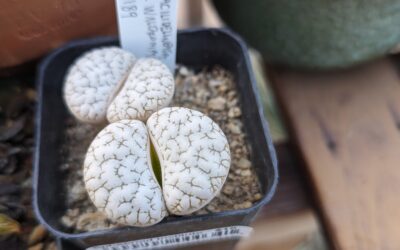
Conophytums are one of those mesembs that can really grab your attention, your interest, and your obsession – but then also be enormously challenging to grow and keep alive. In fact, I’d argue that they’re up there as one of *the* most challenging mesembs to grow if you’re new to mesembs as a group. They are, for the most part, entirely unforgiving of mistakes when it comes to overwatering, and spend about half the year looking dead or close to it.
Why, then, do we love them so? What is so enticing about plants that look dead half the year, and will actually die if you care for them a little too much?
I can’t speak for everyone else, but for me, it’s the challenge of it. They’re subtle, enchanting little plants whose joy lies in the minute details and the patience required to see them. Their evolution and unique appearance by locale and region is fascinating natural history, and for all that we have so much knowledge about where a given group of the little mesembs originated from, there’s still much we don’t know about them.
I don’t claim to be an expert, but by now, I’ve kept several little Conophytums alive for multiple years and multiple cycles of growth, which should give me enough credibility to share with you some tips on how I’ve grown them successfully and even rectified mistakes. I’ve killed a fair few, and grown plenty from seed as well, so I have a range of experience I can speak to. I’ll start with Conophytum pageae, one of the first I’ve kept successfully and for multiple years, which was a gift from the lovely Steve Hammer when I visited his greenhouses several years ago.

When I first had the little pagae – November 20th, 2022!
I had a hard time reading the initial handwriting on the label, and the name is incorrect. That should be “Bloedzuiger-fontein”, which is near a mine in South Africa and refers to the specific locality of this particular Conophytum.
Notice the color here; the light and exposure in Steve’s greenhouses is better than mine in winter, which is a struggle I’ve had for several years now. This year, I’ve taken my shade cloth off entirely, so we’ll see if it helps…
Anyway, this tiny size and the two heads on the Conophytum pageae is typical for the species and is a standard size to purchase it either in person or have shipped to you. Single-headed specimens of a similar size can be mature enough too, but it’s worth noting that it’s rare for the individual head to be much larger than this. Instead, the plant will divide and grow over time that way.
In Habitat
Conophytum pageae is native to South Africa, like most plants of the genus.
Unfortunately, it is also one of the most illegally collected and traded species of the genus as well. This is a crying shame, as they are fairly easy to grow from seed, and can readily be found from dedicated collectors such as Steve Hammer in the locality and types that collectors are searching for.
Conophytum pageae is typically found as clusters in rocky hills of quartz, and is one of the most widespread species, growing in a variety of rock types. When they grow near rivers, the clusters can be surprisingly large for a mesemb, with some photos of eco-tourists showing specimens the size of softballs or larger!
In Cultivation
Soil for your pageae
This seems like a tricky thing, but as with all the mesembs, once you get it down it’s easier than it seems.
The “trick”, such as it is, is to find the blend that works best for your growing conditions. I’m pretty firmly of the opinion that there is no pre-bagged blend that works perfectly for everyone right out of the bag; you will always need to tinker at least a little bit to make it work the way you need it to.
With that preface, the blend that has worked well for these and my other conophytum in the years since is the tried and true favorite:
If you skip one, skip the orchid bark – you can likely get by just fine with pumice and soil. It’s just helpful for my plants.

A year later, November 2023
“But Jen, what about the ratio of those materials?”, you might be saying.
Conophytum come from the southern region of Africa (including the country so named), and are generally found in really rocky, poor soils with not a lot of organic matter. This means your soil should be similar – but not completely lacking in any organic material whatsoever! Pure inorganic grit is not the answer, people.
So you want a mixture that’s mostly inorganic, gritty material but still has some organic matter for the roots to ‘eat’ and use to grow. For me, that mix is about 3 scoops pumice, 1 to 2 scoops of soil, and 1 scoop of bark. Sometimes a little more bark. I want to see a mix that looks like pumice that got dusted in dirt, and has the bark evenly mixed throughout. If it looks more like dirt with pumice sprinkled in, you’ve got too much soil in your mix. I’m not super scientific or precise about it, but I do know what I’m looking for.
I have some photos below to show you:

The actual soil mix I used to repot several conophytums before sitting down to write this article. Lots of inorganic material (pumice), not a lot of organic material (soil). For me, this works perfectly!

This is what it looks like when the mix is too high in organic material (soil). This is close to what I use for my aloes or cacti, though!
This type of mix accomplishes multiple things:
- Great drainage – if you’re a chronic overwaterer like I often am, this lets the pot dry out quickly, so even if they do get too much water, it’s (relatively) easy for them to recover.
- Airy soil mix – the different sizes of the soil, pumice, and bark particles means it’s an airy mix, which helps the roots grow and prevents rot.
- Even dispersal of organic material – by mixing it up fresh, instead of using a pre-mixed bag, you know how much organic material is included and you can be sure it’s included throughout the pot. During shipping, a pre-mixed bag is likely to settle and the organic material would sift to the bottom.
- Long lasting without becoming impacted – this type of mix is pleasantly resistant to turning into a condensed soil cake that doesn’t absorb any water at all, even if you don’t repot the plant for several years.
If you only have one or two Conophytum, it can seem a bit overkill to get three bags of soil for just a couple dinky little pots, but don’t worry. You’ll get more soon enough. 😉

March, 2024 – repotted into a larger pot to grow out
What’s the tan dirt stuff on top of your pot?
I like experimenting with top dressings, and I have easy access to decomposed granite. I’ve found my conophytums, some other mesembs, and a couple types of cacti do quite well with it as a top dressing that mimics the sandy, hard-packed dirt from their habitat.
I also will use pure pumice as a top dressing, or bark. In summer, the top dressing helps protect the roots for many of my plants with how hot the greenhouse gets.
It also just plain looks nice!
Repotting and Pot Size
Alright, you have the dirt. Now what about pots? When do you repot them? What size pot works?
Timing is crucial here, especially if you’re a relative novice like me. Set yourself up for success by repotting your Conophytum pageae when it’s actively growing. That means sometime after it’s woken up in the fall, and well before it’s started to show signs of going dormant.
For me, that time of year is sometime between November and March, and if I miss the window, I have to wait until the next growing season.
Don’t repot your conophytum when it’s dormant if you can help it.
I have overpotted several of my plants intentionally, as I intend to keep them in those pots for several years. The larger pot size encourages root growth first, and then they start to divide. Because Conophytum pageae can and will become quite large with time, I wanted to encourage this growth by giving the plant enough space to expand. Is this always the right thing to do? Probably not. It’s worked for me, though, and I’ll talk about watering adaptations I’ve made in a bit.
That’s all to say: generally, don’t overpot your plants. If anything, keep them under-potted. The pot should be close to the same size as the plant.
But…if you have a nice soil mix and patience, I’ve found it’s okay to go a little overboard.
Watering your Conophytum pageae
Finally, you’re probably saying.
This is the hardest part! What took you so long to get to this bit?
Well, because…it’s the easiest in its own way.
You water them when they’re awake: when they’re green and you can see them through the papery protective coating, they’re ready to grow and receive water. Give them some, then wait for them to wrinkle and indicate that they’re thirsty.
That’s it. Water them when they look thirsty, no more, no less.
That usually means they need very little water. I can’t even give you a schedule or cadence, because it’s been different every year and even month to month, depending on the weather. You stop watering them when they start to yellow/brown and get the protective covering for dormancy, though.

November, 2024, nice and awake for the season!
Conophytum pageae dormancy
A far more critical part of growing these plants than figuring out the perfect schedule to set for watering is learning the dormancy or seasonal growing cycle. This is the tricky part, for me at least. The plants can move rather quickly through their “seasons”, but you can learn to recognize them and give them what they need.
Growing Season – North American Winter
For us in the northern hemisphere, Conophytum pageae grows in the deeps of winter. Short days, rain, clouds? That’s their cue to grow! This is when they look the best, and if you’re in the Southwest like me (hello, fellow San Diegans!), you’ll find them readily for sale.
This is the time of year to water them when you see them get wrinkly, keep them in bright light, and repot them if you so desire. They’re awake and happy!
For me, this is typically from late November through at least March or April. It’ll extend longer if the plants woke up later or the weather is mild; one year the growing season lasted until June because it stayed so cloudy. Longer days will always tell the plants when it’s time to go to sleep, though.

February 20th, 2024

December 20th, 2025 – recently refreshed top dressing
Prep for Dormancy – North American Early Summer
This depends heavily on the local weather. If it’s unusually hot, they go to sleep earlier, and if it’s mild, they’ll hang out longer. Last year (2025) it was surprisingly mild for a long time, and my Conophytum barely even made proper protective coverings.
They’ll spend several weeks slowly looking worse and worse. If you don’t know what to expect, it’s easy to panic and start to water them or try to “save” them – and kill them instead. At this stage, you should just leave them alone. Let them dry out. They need to dry out; they are no longer growing and water will just turn them to rot.
This can be one of the hardest times, but they really just want to be left alone. This is usually the time when I’ll move them all under my benches, tucked into a corner where they’ll be shaded and sheltered from too much overspray as I water the rest of the greenhouse. You may not need to do this, but I’ve found that my plants scorch or dry out too much during the summer, so they get a little trip every year.

May 20th 2024 – notice the wrinkles?

June 5th, 2024 – turning yellower and shrinking down into the pot.
Dormancy – North American Summer
Conophytum of all kinds will usually look quite dead during their dormancy, but they’re not. They’re just preserving energy for the next growing season!
If you have your plants out in a greenhouse wherre it’s quite warm and dry, you may need to give them a little extra moisture during the dormancy season to prevent their roots from dessicating too much. This doesn’t have to be much – just a little splash with your hands over the top of them, or the mist of overspray as you water other plants.
In general, they really, truly don’t need water at this point of the year. I really only make an effort if we have a heat wave, and I know it’ll be over 120F in the greenhouse. Moving my conos under the bench helps keep them cool and prevents them from overheating, which they need while dormant.
This period lasts from June to about September, sometimes into October, depending on how hot of a year it is.

July 29th, 2024 – deep into dormancy

August 18th, 2025 – mild early summer meant the old plant body didn’t dry out as much as usual.
Wakeup Season – North American Fall
This can be anytime from September to November, and it’s recognizable by the Conophytum peeking its little head out of the papery old skin of the previous year’s plant body. The plant has just spent all summer looking dead, or nearly dead, and you’ll notice it’s wake-up time because it’ll suddenly plump up when you water nearby.

September 19th, 2025

October 19th, 2025
Light
Last but definitely not least: light for your Conophytum pageae!
You’ll notice my plant is much greener in my care than it was when I first got it from Steve. My greenhouse setup gets shade in winter from a nearby tree, so while the plants are growing and thriving, they are unfortunately not getting enough sun to turn that pretty blushing purple color.
What does that mean for you?
It’s easy to tell when your own Conophytum is getting enough light, and well before it starts to stretch or rot away. Ideally, set them up with full morning sun, and just a bit of shade during the hottest part of the day. In winter, you can likely leave them in full sun the entire day. Whether or not the little ‘lips’ blush pink, or the full body darkens up, will tell you if they’re getting enough light or not.
If you’re attempting to grow them indoors, I’d recommend a decent grow light setup rather than a window. I’m not going to link any lights, as I’ve never successfully grown them indoors – but I can tell you to steer clear of those cheap, clip-on purple lights. You’ll want an even distribution of light and the full light spectrum, and those lights don’t provide it. They might work in a pinch, but not for the long term.
That’s a wrap!
I hope this helps you grow Conophytum pageae – I won’t tell you they’re easy, but once you figure out what works for your conditions, it gets easier.
Good luck!